
Many people work hard. They wake up early, sleep late, do many things, try many options, and keep pushing. Yet, after all the effort, the results may still be small, slow, or disappointing.
LISTEN TO INTERESTING AUDIO ON THE TOPIC
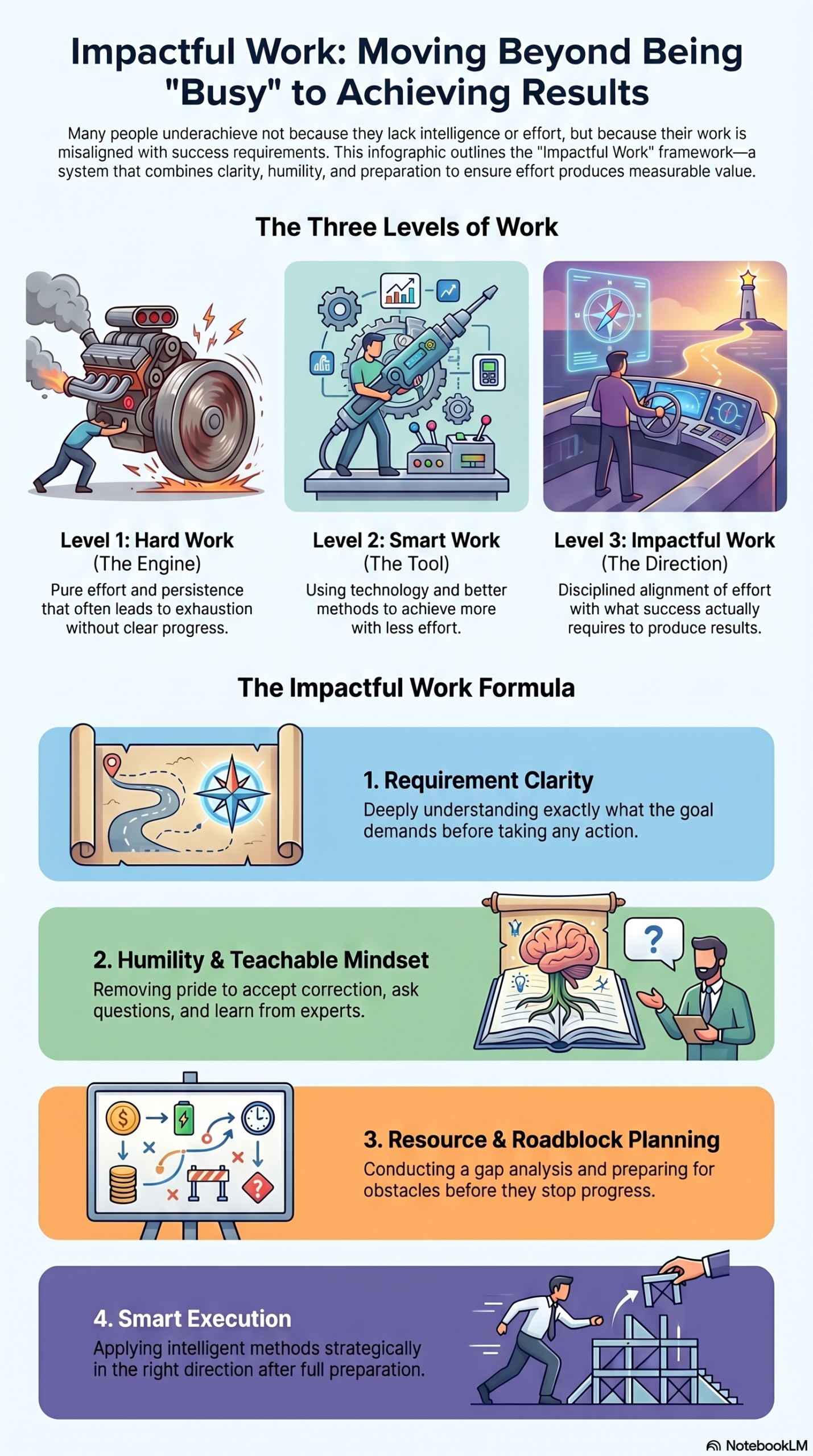
Many other people try to work smart. They use better ideas, technology, shortcuts, tools, creativity, and intelligent methods. They try to avoid unnecessary stress and achieve more with less effort. Smart work is better than blind hard work, but even smart work is not always enough to produce great results.
This course teaches a higher level of work called impactful work.
Impactful work is not just about being busy. It is not just about being clever. It is the disciplined ability to understand what is truly required, remove pride, accept correction, gather the necessary resources, prepare for roadblocks, and then work smart in the right direction.
The course is built on one central idea:
Hard work gives effort. Smart work gives intelligent methods. Impactful work gives direction, preparation, discipline, resources, resilience, and measurable results.
Many people underachieve not because they are lazy. Many underachieve not because they lack intelligence. Some even have resources, contacts, education, or opportunities, yet they still do not produce the level of results they desire. The real problem is often that their work is not properly aligned with what success actually requires.
- They work hard on the wrong things.
- They work smart without enough preparation.
- They use resources without a clear structure.
- They protect their pride instead of accepting correction.
- They move fast without preparing for roadblocks.
- They confuse activity with achievement.
This course helps learners correct these mistakes and develop a practical method for producing results.

Course Aim
The aim of this course is to help learners move beyond ordinary hard work and basic smart work into impactful work: a higher level of effort that is guided by clarity, humility, preparation, resources, strategy, disciplined execution, and measurable results.
Course Objectives
By the end of this course, learners should be able to:
- Explain the difference between hard work, smart work, and impactful work.
- Identify why hard work alone often fails to produce great results.
- Explain why smart work is useful but still limited when it is not guided by real requirements.
- Recognize why many intelligent, hardworking, and resourceful people still underachieve.
- Identify the hidden requirements behind any serious goal, project, business, or assignment.
- Recognize how pride blocks learning, correction, collaboration, and achievement.
- Conduct a resource gap analysis for a personal, business, academic, or professional goal.
- Prepare a roadblock response plan before beginning a major task.
- Apply smart work only after the correct preparation has been done.
- Create a complete Impactful Work Plan for achieving a meaningful result.
The Core Framework
The Impactful Work Formula
Impactful Work = Requirement Clarity + Humility + Resources + Roadblock Planning + Smart Execution
This formula means that real results are not produced by effort alone. Real results require a complete system.
1. Requirement Clarity
You must understand what the result actually demands.
2. Humility
You must be willing to learn, ask questions, accept correction, and remove pride.
3. Resources
You must know what you need, what you have, what is missing, and how to get it.
4. Roadblock Planning
You must prepare for obstacles before they stop you.
5. Smart Execution
You must now work intelligently, consistently, strategically, and in the right direction.
Course Learning Outcomes
After completing the course, learners should be able to demonstrate the following:
- The meaning and limits of hard work.
- The meaning and limits of smart work.
- The concept of impactful work as the next level after smart work.
- The role of requirement clarity in achieving results.
- The role of humility and teachability in personal and professional growth.
- The importance of resources, planning, and roadblock management.
- The difference between outputs, outcomes, and impact.
Skill Outcomes
Learners should be able to:
- Audit their current work habits.
- Redesign scattered effort into focused effort.
- Map the requirements of a goal.
- Identify missing resources.
- Build a roadblock response plan.
- Develop a smart execution strategy.
- Measure whether their work is producing useful results.
Attitude Outcomes
Learners should develop:
- A humble and teachable mindset.
- A disciplined attitude toward preparation.
- A results-oriented view of effort.
- A willingness to seek correction and expert guidance.
- A stronger commitment to producing value, not merely staying busy.
